Inside The Character · Research
Working Paper No. 01 · Haziran / June 2026
Working the Gap
Boşluğu Çalışmak
Inside The Character as a Trauma-Sensitive, Personalised Method of Character Construction
Beyti Engin · Filiz Kaya Ataklı
Beyti Engin — Actor · Acting Coach · Founder, Inside The Character
Filiz Kaya Ataklı — Uzman Psikolog / Specialist Psychologist · Co-developer, Inside The Character
Kavramsal makale (position paper) · practice-based research · TR / EN
Öz / Abstract
TROyuncu eğitiminde karakter inşası uzun süredir, metnin verdiği sahnelerin yorumlanmasına dayanır. Oysa bir karakter yalnızca sahnede göründüğü anlarda var değildir; metnin yazmadığı — oyun öncesindeki, sahneler arasındaki ve karakterin metinde son görüldüğü ana kadar uzanan — yaşamıyla da vardır. Inside The Character (ITC), bu yazılmamış yaşamı oyuncu çalışmasının birincil nesnesine dönüştüren, atölye pratiğinden doğmuş bir yöntemdir. Yöntemin çıkış noktası karakter değil, oyuncudur: çalışma, oyuncunun kendi çalışma biçimini ve yaratıcı yönelimini fark etmesiyle başlar ve karakter, baştan itibaren o oyuncuya özgü biçimde yapılandırılır. Karakterin değiştirilemez doğruları — bir binanın kolonları gibi, yorumun eksenini ve sınırını belirleyen sabitler — saptanır; karakterin yaşamı oyun öncesinden son ana dek bir zaman çizgisi üzerinde dramaturjik bütünlükle kurulur; ve bu yaşam, zihinde canlandırma yoluyla, oyuncunun zihninde karaktere ait anılar olarak var edilir. Yöntemin ayırt edici yanı bu kurgunun öznel olmasıdır: çıkış noktası oyuncunun kendi çalışma biçimi olduğu için, aynı karakter için bile her oyuncu kendi özgün görünmeyen yaşamını yaratır. ITC bir kuram sentezi değildir; Beyti Engin'in Uzman Psikolog Filiz Kaya Ataklı ile birlikte, yirmi yılı aşkın uygulamadan damıttığı bir pratiktir ve sonradan, performans psikolojisi, anlatısal kimlik ve travma-duyarlı pedagoji gibi yerleşik çerçevelerle örtüştüğü görülmüştür. Yöntem ayrıca, yoğun içerikle çalışırken oyuncuyu desteklemeyi ve gereksiz yıpranmayı azaltmayı amaçlayan bir güvenli çıkış protokolü içerir. Ampirik doğrulama henüz yapılmamıştır; bilinçle işaretlenen bir sınırdır.
ENCharacter construction in actor training has long rested on interpreting the scenes the text provides. Yet a character does not exist only in the moments it appears on stage; it also exists in the life left unwritten by the text — before the play, between scenes, and up to the last moment the character is seen in the text. Inside The Character (ITC) is a method, grown from workshop practice, that turns this unwritten life into a primary object of the actor's work. Its point of departure is not the character but the actor: the work begins with the actor becoming aware of their own working profile and creative orientation, and the character is, from the outset, constructed in a way specific to that actor. The character's immutable truths — fixed points that, like the columns of a building, set the axis and the limits of interpretation — are identified; the character's life is built along a timeline, with dramaturgical coherence, from before the play to the final moment; and that life is brought into being, through mental imagery, as memories belonging to the character in the actor's mind. What distinguishes the method is that this construction is subjective: because the point of departure is the actor's own working profile, even for the same character each actor creates their own unique unseen life. ITC is not a synthesis of theory but a practice distilled by Beyti Engin, together with psychologist Filiz Kaya Ataklı, from more than twenty years of application, later found to resonate with established frameworks such as performance psychology, narrative identity, and trauma-sensitive pedagogy. It also includes a safe-exit protocol designed to support the actor and reduce unnecessary strain while working with intense content. Empirical validation has not yet been undertaken; this is a deliberately flagged limit.
1 · YÖNTEMİN KAYNAĞI / THE ORIGIN OF THE METHOD
TRInside The Character bir literatür sentezi olarak tasarlanmadı. Atölye pratiğinden doğdu. 2005'ten bu yana, Uzman Psikolog Filiz Kaya Ataklı ile birlikte, oyuncunun karaktere nasıl hazırlandığı ve zihinde canlandırma yoluyla karakterin iç yaşamını nasıl kurduğu üzerine çalıştık. 2015'te kendi atölyemizi kurduk ve yöntemi, yıllar içinde, 100'den fazla profesyonel oyuncuyla sahada denedik ve biçimlendirdik. Yöntem uluslararası ilgiyi ilk kez 2019'da gördü: Prof. Pia Podgornik'in daveti üzerine Stuttgart'ta bir atölye yürüttüm; 2022'de Filiz Kaya Ataklı ile birlikte aynı kurumda öğrencilere yönelik ikinci bir atölye gerçekleştirdik. Bu makale, geriye dönük bir haritalama girişimidir. Yazar bir kuramcı değil, bir uygulayıcıdır; herhangi bir oyunculuk ekolünün derinlemesine kuramsal incelemesini yaparak değil, yıllarca oyuncularla çalışarak bu yönteme vardı. Aşağıda anılan yerleşik çerçeveler — verili koşullar, zihinde canlandırma, anlatısal kimlik, travma-duyarlı pedagoji — yöntemin kaynakları değildir; pratikte varılan yerin sonradan örtüştüğü görülen referans noktalarıdır. Yöntemin özgünlük iddiası bu çerçeveleri bilmekte ya da birleştirmekte değil; metnin yazmadığı yaşamı sistematik bir çalışma nesnesine dönüştürme probleminde ve bunun için geliştirilen dramaturjik yolculukta yatar.
ENInside The Character was not designed as a synthesis of literature. It grew out of workshop practice. Since 2005, together with psychologist Filiz Kaya Ataklı, we have worked on how an actor prepares for a character and how, through mental imagery, the character's inner life is built. In 2015 we founded our own studio and, over the following years, tested and shaped the method in the field with more than 100 professional actors. The method first drew international interest in 2019, when, at the invitation of Prof. Pia Podgornik, I led a workshop in Stuttgart; in 2022, together with Filiz Kaya Ataklı, we held a second workshop for students at the same institution. This paper is a retrospective mapping. The author is not a theorist but a practitioner; he arrived at this method not through a deep theoretical study of any acting school, but through years of working with actors. The established frameworks referred to below — given circumstances, mental imagery, narrative identity, trauma-sensitive pedagogy — are not the sources of the method; they are reference points that the practice was later found to resonate with. The method's claim to originality lies not in knowing or combining these frameworks, but in the problem of turning the life the text does not write into a systematic object of work, and in the dramaturgical journey developed to address it.
2 · PROBLEM: ZAMAN, DERİNLİK VE BİR ALAN İHTİYACI
TRBu yöntem iki problemden doğdu; biri çok somut, biri daha örtük. Birincisi, Türkiye'de çalışan bir oyuncunun gündelik gerçeğidir. Önemli bir karaktere çoğu zaman bir haftadan kısa sürede — bazen birkaç gün, bazen birkaç saatte — hazırlanıp sete çıkmak gerekir. Senaryo sıklıkla çekimden bir gün önce, hatta o sabah oyuncunun eline geçer. Bu koşullarda oyuncunun enerjisi büyük ölçüde teknik olarak oyunculuk yapabilmeye gider; karakterin derinine inecek, devamlılığını kuracak zaman neredeyse hiç kalmaz. Klasik ekollerin zengin karakter çalışması burada bir lüks gibi durur, çünkü o çalışma uzun prova süreçlerini ve eğitmen eşliğini varsayar — Türk oyuncusunun çoğu zaman sahip olmadığı şeyleri. İkincisi, uluslararası çalışmaya başladığımda fark ettiğim, daha sessiz bir problemdir. Türkiye'deki kadar sert bir zaman baskısı olmayan yerlerde bile oyuncular benzer bir eksikle karşılaşıyordu: zaman olsa dahi, karakterin derinliğini nerede ve nasıl yaratacaklarına dair bir alanın yokluğu. Sorun yalnızca zaman değildi; derinliğe inilecek yapılandırılmış bir alanın olmamasıydı. Her iki problemin de kökünde aynı ihtiyaç yatıyordu: oyuncunun karakterin derinine inebileceği, çalışabileceği bir alan yaratmak. Elimizde aslında çok şey var — her şeyden önce yazarın verdiği metin. Mesele metnin yetersizliği değil, ona nasıl bakıldığıdır. Ben bir metne baktığımda, satır aralarındaki boşluklar zihnimde öncesi ve sonrasıyla kendiliğinden dolar; karakterin görmediğimiz yaşamı belirir. Yıllardır üzerinde çalıştığım soru şuydu: oyuncuya da böyle baktırabilir miyim? Onun da metnin yazmadığı yaşamı görmesini sağlayabilir miyim? ITC, bu soruya verilmiş sistematik bir yanıttır — metne bakmanın, boşluğu görmenin ve onu doldurmanın öğretilebilir bir biçimi.
ENThis method arose from two problems — one very concrete, one more implicit. The first is the daily reality of an actor working in Turkey. A significant character must often be prepared in less than a week — sometimes in a few days, sometimes a few hours — before stepping onto set. The script frequently reaches the actor the day before shooting, or even that morning. Under these conditions, most of the actor's energy goes to performing technically; there is almost no time left to go deep into the character or to build its continuity. The rich character work of the classical schools looks like a luxury here, because it presupposes long rehearsal and the company of an instructor — things the Turkish actor often does not have. The second is a quieter problem I noticed once I began working internationally. Even in places without Turkey's harsh time pressure, actors faced a similar lack: even when time was available, there was no space for where and how to create the character's depth. The problem was not only time; it was the absence of a structured space in which to descend into depth. At the root of both problems lay the same need: to create a space in which the actor can go into the depth of the character and work. We actually have a great deal at hand — above all, the text the writer gives. The issue is not the text's insufficiency but how it is read. When I look at a text, the gaps between the lines fill of their own accord in my mind, with what came before and after; the character's unseen life appears. The question I have worked on for years was this: can I make the actor see this way too? Can I enable them to see the life the text does not write? ITC is a systematic answer to that question — a teachable way of looking at the text, seeing the gap, and filling it.
3 · MERKEZÎ TEZ: BOŞLUK BİR ÇALIŞMA NESNESİDİR
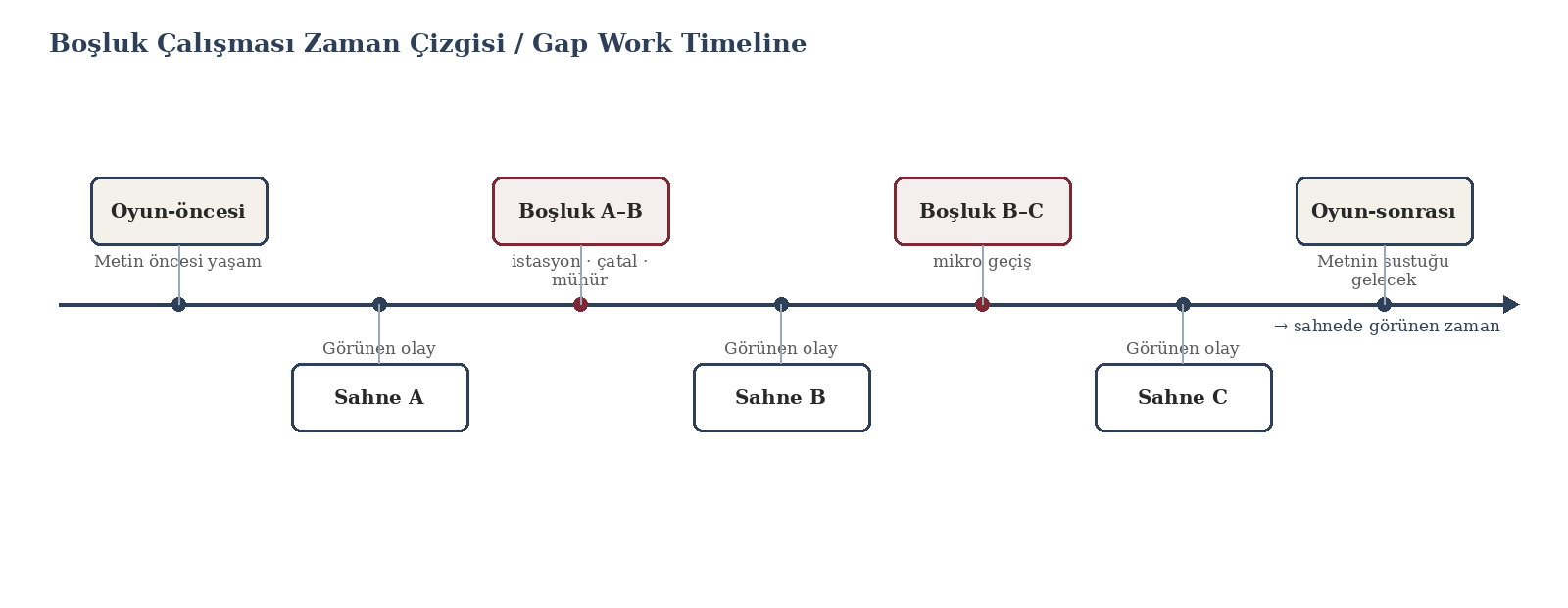
TRBir oyun ya da senaryo, karakterin yaşamının yalnızca bir kısmını yazar. Sahneler, o yaşamdan seçilmiş anlardır; aralarında, öncesinde ve sonrasında yazılmamış geniş bir zaman uzanır. Hamlet'i ilk gördüğümüzde baba çoktan ölmüştür — ama o babayla geçen yıllar, kayıptan önceki dünya, metinde yoktur. Nina'yı üçüncü perdeden dördüncüye taşıyan iki yıl boyunca yaşananları Çehov hiç göstermez. Bu yazılmamış zaman, geleneksel olarak "arka plan" sayılır: sahneyi besleyen, ama üzerinde doğrudan çalışılmayan bir doku. Doldurulması çoğu zaman oyuncunun sezgisine bırakılır. ITC'nin merkezî tezi şudur: bu boşluk arka plan değildir; sahnenin eşitidir. Karakter, yalnızca sahnede göründüğü anlarda var olmaz — sahneye çıkmadan önce de, sahneler arasında da, metinde son görüldüğü ana kadar da vardır. Bir karakteri bütün olarak oynayabilmek, onu yalnızca göründüğü anlarda değil, görünmediği tüm anlarda da var edebilmeyi gerektirir. Dolayısıyla yazılmamış yaşam, sezgiye bırakılan bir boşluk olmaktan çıkıp, üzerinde sistematik olarak çalışılan birincil bir nesneye dönüşür. Bu dönüşüm, yöntemin can damarıdır. Klasik gelenek boşluğu kabul eder — Stanislavski verili koşulları sorar, oyuncuların "sahne arkasında da yaşamaya" devam etmesi öğütlenir — ama boşluk neredeyse hiçbir zaman sahneyle eşit ağırlıkta, kendi başına çalışılan bir birim olarak ele alınmaz. ITC'nin yaptığı, boşluğu statü olarak yükseltmektir: arka plandan birincil nesneye, sezgiden yönteme, sahneyi besleyen dokudan zaman çizgisi üzerinde çalışılan eşdeğer bir alana. Kısaca: boşluk artık sahnenin gölgesi değil, sahnenin eşitidir.
ENA play or a screenplay writes only part of a character's life. The scenes are selected moments from that life; before them, between them, and up to the character's final textual moment stretches a vast unwritten time. When we first see Hamlet, the father is already dead — but the years spent with that father, the world before the loss, are not in the text. Chekhov never shows what happens during the two years that carry Nina from the third act to the fourth. This unwritten time is traditionally treated as "background": a texture that feeds the scene but is not worked upon directly. Filling it is usually left to the actor's intuition. ITC's central thesis is this: this gap is not background; it is treated as equal in weight to the scene. A character does not exist only in the moments it appears on stage — it exists before stepping on, between scenes, and up to the last moment it is seen in the text. To play a character whole is to be able to bring it into being not only in the moments it is seen but in all the moments it is not seen. The unwritten life thus ceases to be a gap left to intuition and becomes a primary object worked upon systematically. This shift is the lifeblood of the method. The classical tradition acknowledges the gap — Stanislavski asks after given circumstances, actors are urged to "go on living offstage" — yet the gap is almost never treated as a unit worked upon in its own right, equal in weight to the scene. What ITC does is to raise the gap in status: from background to primary object, from intuition to method, from supporting texture to an equal field worked upon on the timeline. In short: the gap is no longer the shadow of the scene but its equal.
4 · YÖNTEMİN İKİ İLKESİ
TRBoşluğu bir çalışma nesnesine dönüştürmek, onu nasıl dolduracağımız sorusunu doğurur. ITC bu soruyu iki ilkeyle yanıtlar. Çıkış noktası: oyuncu. Yöntemin belki de en ayırt edici yanı, karakterden değil oyuncudan başlamasıdır. Çalışma, oyuncunun kendi çalışma biçimini ve algılama yönelimini fark etmesiyle açılır; karakter, en baştan itibaren o oyuncuya özgü biçimde yapılandırılır. Bunun sonucu şudur: aynı karakter, farklı oyuncularda farklı görünmeyen yaşamlar üretir. On oyuncu aynı Hamlet'i çalışsa, on farklı — ama her biri tutarlı — yazılmamış yaşam ortaya çıkar. Yöntem oyuncuya tek bir "doğru" yorum dayatmaz; her oyuncunun, kendi öznelliğinde, özgün bir karakter kurmasını sağlar. Bu yüzden ITC'de iyi çalışmanın ölçütü doğruluk değildir: doğru analiz yoktur, iyi yapılmış analiz vardır. Birinci ilke: değiştirilemez doğrular. Oyuncunun kuracağı bu öznel yaşam sınırsız değildir. Metin, karakter hakkında değiştirilemez birtakım gerçekler sabitler — kim olduğu, neyi kaybettiği, neye bağlı olduğu gibi. Bunlara değiştirilemez doğrular diyoruz. Bir binanın kolonları gibidirler: yapının ayakta durmasını sağlar, yolculuğun eksenini çizer ve dışına taşılmaması gereken sınırı belirler. Bu doğrular, oyuncunun öznel sabitlerinden ayrıdır: değiştirilemez doğrular metnin koyduğu nesnel kolonlardır; öznel sabitler ise oyuncunun bu kolonlar içinde kurduğu, karaktere özgü yorum cümleleridir. Oyuncu boşluğu özgürce kurabilir — ama bu kurgu, kolonların içinde kalmak zorundadır. Bu yönüyle değiştirilemez doğrular, Stanislavski'nin verili koşullarıyla örtüşür; ama bir farkla: verili koşul çoğunlukla bir durumu betimlerken, değiştirilemez doğru oyuncuyu harekete geçiren bir taşıyıcıdır — yalnızca neyin doğru olduğunu değil, o doğrunun karakteri nereye ittiğini de tutar. İkinci ilke: karakterin kendi verisi. Boşluk doldurulurken kullanılan malzeme, oyuncunun kendi yaşamı ya da travması değil, karakterin kendi verisidir. Geleneksel yaklaşımların bir kısmı oyuncuyu kendi yarasına dönmeye çağırır; ITC bunu bir zorunluluk olmaktan çıkarır. Varsayılan kibrit, oyuncunun yarasında değil, karakterin verisinde yakılır. Bu, yaratıcı alanı daraltmaz — tersine, güçlü bir karakterin kişisel acıya başvurmadan da kurulabileceğini söyler. İlke hem etiktir hem pratiktir: oyuncuyu korur, ve karakteri oyuncudan bağımsız bir bütünlük olarak ele alır.
ENTurning the gap into an object of work raises the question of how to fill it. ITC answers this with two principles. The point of departure: the actor. Perhaps the method's most distinctive feature is that it begins not with the character but with the actor. The work opens with the actor becoming aware of their own working profile and preferred mode of access; the character is, from the very beginning, constructed in a way specific to that actor. The consequence is this: the same character produces different unseen lives in different actors. If ten actors work the same Hamlet, ten different — yet each coherent — unwritten lives emerge. The method imposes no single "correct" interpretation; it enables each actor to build an original character within their own subjectivity. This is why, in ITC, the measure of good work is not correctness: there is no correct analysis, only analysis done well. First principle: immutable truths. The subjective life the actor builds is not boundless. The text fixes certain unalterable facts about the character — who they are, what they have lost, what they are bound to. We call these immutable truths. They are like the columns of a building: they hold the structure up, draw the axis of the journey, and set the limits beyond which one must not stray. These truths are distinct from the actor's subjective constants: the immutable truths are the objective columns the text sets, while the subjective constants are the character-specific lines of interpretation the actor builds within those columns. The actor may build the gap freely — but that construction must remain within the columns. In this respect immutable truths resonate with Stanislavski's given circumstances; but with a difference: where a given circumstance most often describes a situation, an immutable truth is a carrier that moves the actor to act — it holds not only what is true but where that truth pushes the character. Second principle: the character's own data. The material used to fill the gap is not the actor's own life or trauma, but the character's own data. Some traditional approaches call the actor to return to their own wound; ITC removes this as a requirement. The default match is struck not on the actor's wound but on the character's data. This does not narrow the creative field — on the contrary, it states that a powerful character can be built without recourse to personal pain. The principle is both ethical and practical: it protects the actor, and it treats the character as a coherence independent of the actor.
5 · ZAMAN ÇİZGİSİ VE YOLCULUK
TRDeğiştirilemez doğrular saptandığında, karakterin yaşamı artık bir eksen üzerine yerleştirilebilir. ITC bu yaşamı bir zaman çizgisi olarak kurar: oyun öncesinden başlayıp, perdenin açıldığı ana, oradan da karakteri son gördüğümüz ana kadar uzanan kesintisiz bir hat. Sahneler bu hattın görünen duraklarıdır; boşluklar ise aralarındaki, üzerinde çalışılan yazılmamış zamandır. Amaç, karakteri parça parça değil, baştan sona dramaturjik bir bütünlük içinde görebilmektir — yalnızca sahnede var olduğu anlarda değil, var olduğu bütün anlarda. Bu zaman çizgisi saptanıp görselleştirildikten sonra, çalışmanın ikinci evresi başlar: yolculuk. Oyuncu, kurduğu bu yaşamı zihinde canlandırma yoluyla içeriden deneyimler. Boşluklar ve sahne anları, soyut bilgiler ya da analiz notları olarak değil, karaktere ait anılar olarak oyuncunun zihninde var edilir. Yolculuğun sonunda oyuncu, karakterin geçmişini "bilen" biri değil, onu yaşamış biri gibi sahneye çıkar: çünkü o anlar artık karakterin — ve dolayısıyla oyuncunun erişebildiği — bir belleğin parçasıdır. Bu, yöntemin neden yalnızca bir analiz tekniği olmadığını gösterir. Analiz karakteri anlamayı sağlar; ITC'nin yolculuğu ise onu hatırlanabilir kılar. Bir oyuncu sahnede, daha önce zihninde yaşadığı bir anın ağırlığını taşır — metnin hiç yazmadığı, ama kendisi için artık gerçek olan bir geçmişin ağırlığını. Karakterin görünmeyen yaşamı, böylece bir bilgi olmaktan çıkıp bir deneyime dönüşür.
ENOnce the immutable truths are identified, the character's life can be placed on an axis. ITC constructs this life as a timeline: an unbroken line beginning before the play, reaching the moment the curtain rises, and extending to the last moment we see the character. The scenes are the visible stops along this line; the gaps are the unwritten time between them, worked upon. The aim is to see the character not piece by piece but in dramaturgical coherence from beginning to end — not only in the moments it exists on stage, but in all the moments it exists. Once this timeline is identified and visualised, the second phase of the work begins: the journey. The actor experiences the life they have built from within, through mental imagery. The gaps and the scene-moments are brought into being in the actor's mind not as abstract information or analysis notes, but as memories belonging to the character. At the end of the journey the actor steps onto the stage not as someone who "knows" the character's past, but as someone who has lived it — because those moments are now part of a memory belonging to the character, and therefore accessible to the actor. This is what shows that the method is not merely an analytic technique. Analysis lets one understand the character; ITC's journey makes the character available as lived, memory-like material. On stage the actor carries the weight of a moment they have already lived in the mind — the weight of a past the text never wrote, but which is now real for them. The character's unseen life thus ceases to be knowledge and becomes experience.
6 · ALANDAKİ YER
TRITC bir kuram sentezi olarak doğmadı; pratikten doğdu. Ne var ki bir yöntem, alanın neresinde durduğunu bilmek zorundadır. Yöntemi yıllarca uyguladıktan sonra geriye dönüp baktığımda, vardığım yerin birkaç yerleşik çerçeveyle örtüştüğünü gördüm. Bu örtüşmeleri burada kaynak olarak değil, yöntemin alandaki yerini gösteren referans noktaları olarak anıyorum. Oyunculuk geleneğinde verili koşullar, sahne-dışı yaşam, karakterin geçmişinin araştırılması ve hayal gücü gibi başlıklar, boşluğun varlığına farklı biçimlerde çoktan temas etmişti; ITC bu mirası reddetmez, yalnızca boşluğun statüsünü değiştirir (Bölüm 3). Performans psikolojisinde, zihinde canlandırmanın bireyselleştirilebilir olduğunu ortaya koyan çalışmalar vardır; ITC'nin uzun süredir uyguladığı, oyuncunun kendi çalışma biçimine ve algılama yönelimine göre biçimlenen canlandırma pratiği bu literatürle örtüşür. Karakterin yaşamını geçmiş/şimdi/gelecek ekseninde kurma yaklaşımı, anlatısal kimlik kuramının betimlediği eğilimle — insanların yaşamlarını içselleştirilmiş bir hikâye olarak örgütleme eğilimiyle — gevşek bir analoji kurar; ikisi birebir aynı şey değildir, ama aynı yönde düşünmeye izin verir. Ve yöntemin oyuncuyu koruyan yanı, travma-duyarlı pedagojinin ilkeleriyle aynı yöne bakar. Bu örtüşmelerin hiçbiri ITC'nin kaynağı değildir; yöntem bunlardan türetilmedi. Önemli olan, bunların ITC tarafından icat edilmediğinin açıkça kabul edilmesidir — çünkü yöntemin değeri icatta değil, bu farklı içgörülerin tek bir oyuncu-merkezli pratikte, daha önce kurulmamış biçimde bir araya gelmesindedir.
ENITC was not born as a synthesis of theory; it was born of practice. Yet a method must know where it stands in its field. Looking back after years of applying the method, I saw that where I had arrived resonated with several established frameworks. I cite these resonances here not as sources but as reference points that locate the method in its field. In the acting tradition, headings such as given circumstances, off-stage life, the investigation of a character's past, and imagination have long touched, in different ways, on the existence of the gap; ITC does not reject this inheritance, it only changes the status of the gap (Section 3). In performance psychology there is work showing that mental imagery can be individualised; ITC's long-standing practice of imagery shaped by the actor's working profile and preferred mode of access resonates with this literature. The approach of building the character's life along a past/present/future axis resonates loosely with the tendency narrative identity theory describes — the human tendency to organise life as an internalised story. The two are not the same thing, but they offer a useful analogy. And the method's protection of the actor looks in the same direction as the principles of trauma-sensitive pedagogy. None of these resonances is the source of ITC; the method was not derived from them. What matters is the open acknowledgement that they are not invented by ITC — because the value of the method lies not in invention but in bringing these different insights together within a single actor-centred practice, in a way not previously assembled.
7 · GÜVENLİK MİMARİSİ
TRKarakterin yazılmamış yaşamını kurmak, zaman zaman yoğun ya da zorlayıcı malzemeyle çalışmayı gerektirir. ITC bu noktada iki şey yapar. Birincisi, yoğun ya da hassas içerik, Beyti Engin ve Uzman Psikolog Filiz Kaya Ataklı'nın ortak değerlendirmesinden geçerek dramatik açıdan hassas anlar olarak işaretlenir. Bu bir tanı, psikometrik ölçüm ya da terapötik değerlendirme değildir; belirli içeriklerin dramaturjik ağırlığını ve oyuncuyu zorlayabilecek yanını önceden görünür kılan bir içerik işaretlemesidir. İşaret bir engel değildir — hiçbir içerik oyuncuya kapatılmaz; işaret yalnızca bir uyarı taşır ve gereken yerde koruyucu bir adım önerir. İkincisi, yöntem bir güvenli çıkış (de-roling) ilkesi içerir. Oyunculuk eğitimi role girmeyi yıllarca öğretir; rolden güvenle çıkmayı ise çoğu zaman örtük bırakır. ITC bunu açık bir adıma dönüştürür: yoğun bir yolculuğun ardından oyuncunun karakterden kendi bütünlüğüne geri dönmesi, çalışmanın ayrılmaz bir parçasıdır. Bu mimari, ITC'nin baştan beri Uzman Psikolog Filiz Kaya Ataklı ile birlikte geliştirilmiş olmasının doğrudan sonucudur: güvenli geçişi kolaylaştırma kaygısı, sonradan eklenen bir önlem değil, yöntemin kuruluşundan gelen bir ilkedir.
ENBuilding the character's unwritten life sometimes requires working with intense or demanding material. Here ITC does two things. First, intense or sensitive content is marked as dramaturgically sensitive through the joint assessment of Beyti Engin and psychologist Filiz Kaya Ataklı. This is not a diagnosis, a psychometric measurement, or a therapeutic assessment; it is a content-marking that makes visible, in advance, the dramaturgical weight of certain material and the aspect of it that may strain the actor. The mark is not a barrier — no content is closed off to the actor; it only carries a warning and, where needed, suggests a protective step. Second, the method includes a safe-exit (de-roling) principle. Actor training teaches entering a role for years; it often leaves exiting one safely implicit. ITC turns this into an explicit step: after an intense journey, the actor's return from the character to their own integrity is an inseparable part of the work. This architecture is a direct consequence of ITC having been developed, from the very beginning, together with psychologist Filiz Kaya Ataklı: the concern for safe transition is not a measure added afterward but a principle present from the method's founding.
Kapsam ve Sınır / Scope and Boundary
Nedir / What it is: Yöntemin güvenlik katmanı, dramatik açıdan yoğun ya da hassas anları önceden işaretleyen ve oyuncunun rolden güvenle çıkmasını destekleyen pedagojik güvenlik ilkelerinden oluşur. / The safety layer consists of pedagogical safety principles that flag dramatically intense or sensitive moments in advance and support the actor's safe exit from the role.
Ne değildir / What it is not: Bir terapi ya da klinik müdahale, bir tanı aracı, psikometrik ölçüm ya da terapötik değerlendirme değildir. / It is not a therapy or clinical intervention, a diagnostic tool, a psychometric measurement, or a therapeutic assessment.
8 · KARŞI-ARGÜMAN VE DÜRÜST SINIRLAR
TR"Bu kadar yapılandırma oyuncunun sezgisini öldürmez mi?" Yönteme yöneltilebilecek en ciddi itiraz budur. Yanıt, yapılandırmanın amacında yatar: ITC sezginin yerine geçmez, ona zemin hazırlar. Karakterin yaşamını önceden kurmak, sahnede her anı planlamak değildir; tam tersine, oyuncuyu o kadar sağlam bir iç temele oturtur ki sahnede özgürce, sezgisiyle oynayabilir. Önceden kurulan şey bir kafes değil, üzerinde durulacak bir zemindir. Bir oyuncu karakterin geçmişini içeriden bildiğinde, sahnede o bilgiyi düşünmek zorunda kalmaz — onu taşır. Yapılandırma, sezgiyi kısıtlamak için değil, onu serbest bırakacak güveni vermek içindir. Operasyonelleşme. Yöntem, oyuncunun bu yolculuğu bir eğitmen olmadan da sürdürebilmesi için bir dijital araçta operasyonelleştirilmek üzere geliştirilmektedir. Burada önemli bir ayrım vardır: amaç bir uygulama üretmek değil, var olan bir yöntemi bir uygulamaya devredebilmektir. Yöntemin fikirleri uygulamaya değil, yönteme aittir; uygulama yalnızca onların taşıyıcısıdır. Dürüst sınırlar. Bu yazı bir etki çalışması değil, kavramsal bir konum bildirisidir; birkaç sınırı bilinçle işaretler. Birincisi, yöntemin ampirik doğrulaması henüz yapılmamıştır — yıllar içinde çok sayıda oyuncuyla uygulanmış olması saha deneyimi sağlar, ama bu kontrollü bir etki çalışması değildir. İkincisi, yöntem henüz dış ve bağımsız bir akademik değerlendirmeden geçmemiştir; bu yazı kısmen o değerlendirmeye bir davettir. Üçüncüsü, güvenlik mimarisinin bir bölümü hâlâ geliştirme ve gözden geçirme aşamasındadır. Bir doğrulama yol haritası önerilebilir: düşük riskli bir pilot, ardından karşılaştırmalı çalışma, ardından bağımsız uzman değerlendirmesi.
EN"Doesn't all this structure kill the actor's intuition?" This is the most serious objection the method can face. The answer lies in the purpose of the structure: ITC does not replace intuition, it prepares the ground for it. Building the character's life in advance is not planning every moment on stage; on the contrary, it sets the actor on a foundation so solid that they can play freely, by intuition, on stage. What is built in advance is not a cage but a ground to stand on. When an actor knows the character's past from within, they do not have to think about that knowledge on stage — they carry it. Structure exists not to restrict intuition but to give the confidence that sets it free. Operationalisation. The method is being developed to be operationalised in a digital tool, so that the actor can pursue this journey even without an instructor. An important distinction applies here: the aim is not to produce an application but to be able to transfer an existing method into one. The ideas of the method belong to the method, not to the application; the application is only their carrier. Honest limits. This paper is not an efficacy study but a conceptual position statement; it deliberately flags several limits. First, the method has not yet been empirically validated — its application with many actors over the years provides field experience, but this is not a controlled efficacy study. Second, the method has not yet undergone external, independent academic evaluation; this paper is, in part, an invitation to it. Third, part of the safety architecture is still in development and review. A validation pathway can be proposed: a low-risk pilot, then a comparative study, then independent expert evaluation.
9 · SONUÇ
TRBu yazının iddiası bilinçli olarak dar tutulmuştur. ITC'nin "dünyada ilk" ya da "yeni bir kuram" olduğu öne sürülmez; bileşenlerinin oyunculuk geleneğinde ve çevre disiplinlerde var olduğu açıkça kabul edilir. Savunulabilir biçimiyle iddia şudur: bir karakterin yazılmamış yaşamını birincil bir çalışma nesnesine dönüştüren, bunu oyuncunun kendi çalışma biçiminden başlayarak öznel biçimde kuran ve oyuncuyu desteklemeyi amaçlayan bir güvenlik mimarisiyle birleştiren bir oyuncu-eğitimi çerçevesi, yazarın oyunculuk eğitimi pratiğinde karşılaştığı yaklaşımlar içinde bu bütünlükte formüle edilmiş bir örneğine rastlanmamıştır. Yöntemin değeri bir buluşta değil, bu birleşimin tutarlı ve uygulanabilir biçimde kurulmasındadır. Ve yöntem bir kuramcının masasında değil, yirmi yılı aşkın bir süre boyunca, oyuncularla, atölyede doğdu. Bu yazı bir sonuç değil; bir pratiğin kendi üzerine düşünmesinin kaydı ve onu sınamaya yönelik bir davettir.
ENThe claim of this paper is deliberately kept narrow. ITC is not advanced as "a world first" or "a new theory"; it is openly acknowledged that its components exist in the acting tradition and in neighbouring disciplines. In its defensible form, the claim is this: an actor-training framework that turns a character's unwritten life into a primary object of work, builds it subjectively starting from the actor's own working profile, and combines this with a safety architecture designed to support the actor, has — among the approaches the author has encountered in actor-training practice — not been found formulated with this coherence. The value of the method lies not in an invention but in the coherent and applicable construction of this combination. And the method was born not at a theorist's desk but in the workshop, with actors, over more than twenty years. This paper is not a conclusion; it is the record of a practice reflecting on itself, and an invitation to put it to the test.
Bu makale, daha geniş araştırma programı gelişmeye devam ederken, akademik diyaloğa davet amacıyla yapılan erken bir yayındır.
This paper is an early publication intended to invite scholarly dialogue while the broader research programme continues to develop.
İlgili Literatür / Related Reading
Aşağıdaki kaynaklar, metinde işaret edilen örtüşme alanlarıyla ilgili okumalardır; yöntemin türetildiği kaynaklar değildir. / The following are related readings on the areas of resonance noted in the text; they are not sources from which the method was derived.
Bailey, S., & Dickinson, P. (2016). The Importance of Safely De-roling. Methods: A Journal of Acting Pedagogy, 2, 1–18.
Carello, J., & Thompson, P. (Eds.). (2022). Trauma-Informed Pedagogies: A Guide for Responding to Crisis and Inequality in Higher Education. Cham: Palgrave Macmillan.
Hagen, U. (1973). Respect for Acting. New York: Macmillan / John Wiley & Sons.
Holmes, P. S., & Collins, D. J. (2001). The PETTLEP Approach to Motor Imagery: A Functional Equivalence Model for Sport Psychologists. Journal of Applied Sport Psychology, 13(1), 60–83.
McAdams, D. P., & McLean, K. C. (2013). Narrative Identity. Current Directions in Psychological Science, 22(3), 233–238.
Stanislavski, C. (1936). An Actor Prepares (E. R. Hapgood, Çev.). New York: Theatre Arts Books.
Substance Abuse and Mental Health Services Administration (SAMHSA). (2014). SAMHSA's Concept of Trauma and Guidance for a Trauma-Informed Approach. HHS Publication No. (SMA) 14-4884. Rockville, MD: SAMHSA.
Atıf / Citation
Bu çalışma şu biçimde anılabilir / Cite as
Engin, B., & Kaya Ataklı, F. (2026). Working the Gap: Inside The Character as a Trauma-Sensitive, Personalised Method of Character Construction. Inside The Character Working Papers, No. 01. beytienginstudio.com/research/working-the-gap
Permanent link: beytienginstudio.com/research/working-the-gap
© 2026 Beyti Engin & Uzman Psikolog Filiz Kaya Ataklı. Tüm hakları saklıdır. Çekirdek kavramlar yazara aittir. Öznel Sabitler: oyuncunun, değiştirilemez doğrular içinde kalarak kurduğu, karaktere özgü yorum sabitleri. Görünmez Travma Katmanı: dramatik açıdan hassas anları önceden işaretleyerek oyuncuyu destekleyen, yöntemin örtük güvenlik düzeyi. Boşluk-Temelli Karakter İnşası: karakterin yazılmamış zamanını birincil çalışma nesnesine dönüştüren temel yaklaşım.